
About 1.9 people die every second worldwide — that's 165,000 a day and roughly 60 million a year. We break down the math behind StatsPanda's real-time death clock, the leading causes of death, and how the rate has shifted since 2000.
How Many People Die Every Second, Minute, Hour, and Day?
According to UN Department of Economic and Social Affairs estimates, the world experiences roughly 60 million deaths a year. That works out to about 1.9 deaths every second, or — to put it in more intuitive units — almost two people every time you blink. StatsPanda's real-time deaths-today counter is built directly on this rate.
The numbers below show the same crude death rate sliced at different time intervals, computed against the most recent UN population estimate of roughly 8.2 billion. They drift slightly each year as the population grows and as the global mortality profile shifts, but the orders of magnitude are remarkably stable.
| Time Interval | Deaths Worldwide | Roughly Equivalent To |
|---|---|---|
| Per second | 1.9 | Almost 2 people every blink |
| Per minute | 115 | A jumbo-jet seating capacity |
| Per hour | 6,880 | A mid-sized college campus |
| Per day | 165,000 | The population of Pasadena, CA |
| Per week | 1.16 million | The population of Dallas, TX |
| Per year | 60 million | The population of Italy |
The world's crude death rate is currently about 7.4 deaths per 1,000 people per year. That sounds small until you multiply by 8.2 billion — and realize a city the size of Pasadena disappears every single day.
What People Are Actually Dying From
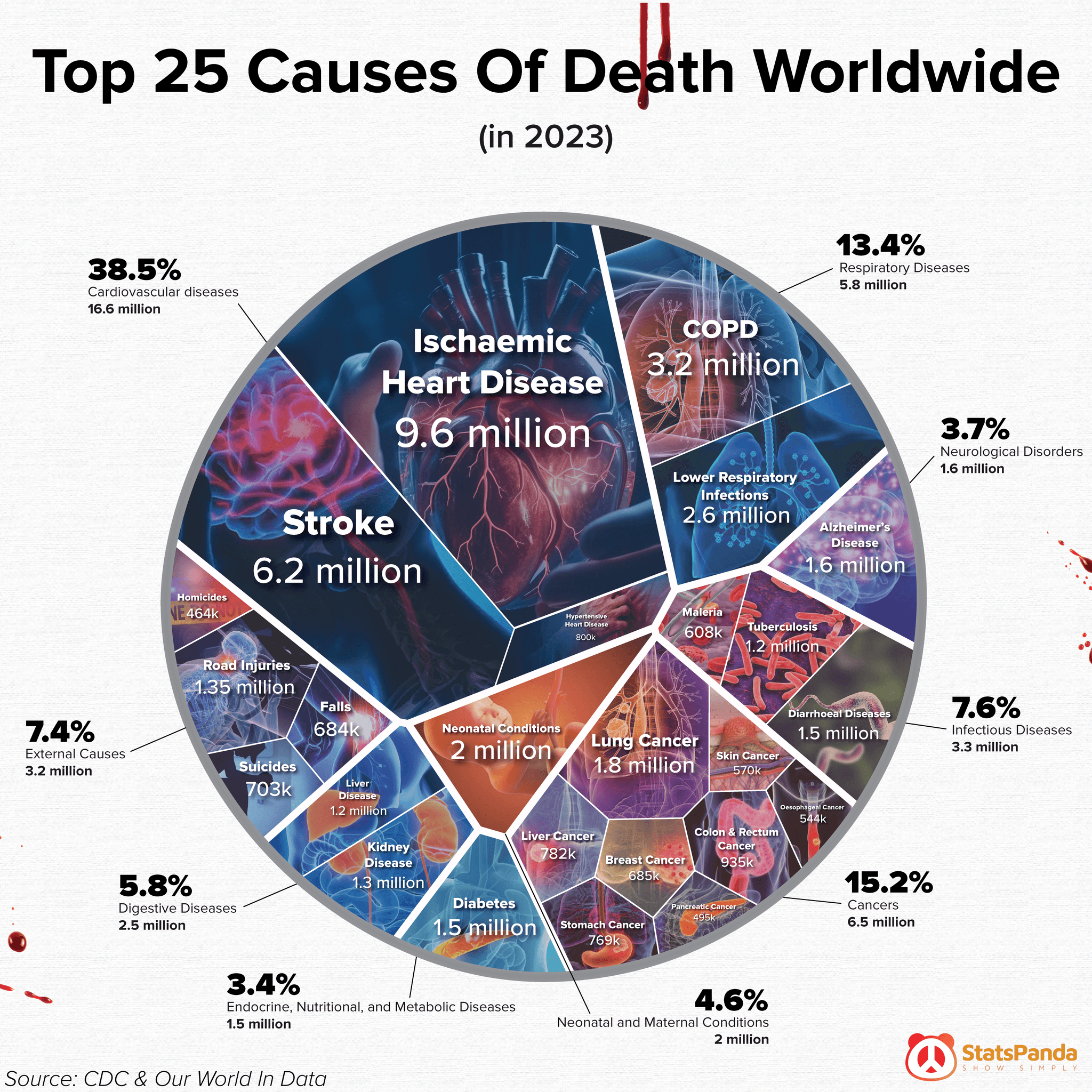
The deaths-per-second figure is an average across every cause — heart disease, accidents, infections, and old age combined. But the distribution is wildly lopsided. According to WHO Global Health Estimates, cardiovascular disease alone accounts for about a third of all deaths, and the top three causes (cardiovascular, cancers, and respiratory) make up nearly two‑thirds of global mortality.
The "noncommunicable" category — heart disease, stroke, cancer, COPD, diabetes — now drives roughly 74% of global deaths, a complete reversal from the early 20th century, when infections and childbirth dominated. The shift is largely a side effect of progress: we've gotten much better at keeping people alive long enough for chronic disease to catch up with them.
| Rank | Cause | Annual Deaths | Share of Total |
|---|---|---|---|
| 1 | Cardiovascular disease | 19.0M | 32% |
| 2 | Cancers | 10.0M | 17% |
| 3 | Chronic respiratory disease | 4.0M | 7% |
| 4 | Lower respiratory infections | 2.5M | 4% |
| 5 | Neonatal conditions | 2.0M | 3% |
| 6 | Alzheimer's & dementias | 1.9M | 3% |
| 7 | Diarrheal diseases | 1.5M | 3% |
| 8 | Diabetes mellitus | 1.5M | 3% |
| 9 | Road traffic injuries | 1.2M | 2% |
| 10 | Tuberculosis | 1.2M | 2% |
How the Global Death Rate Has Changed Since 2000
Total annual deaths have crept upward as the population has grown, but the crude death rate per 1,000 people has actually fallen for most of the past century. The COVID-19 pandemic interrupted that trend dramatically — global deaths jumped roughly 10% in 2020 and 2021 before settling back near baseline by 2023.
If you look only at the totals, it's tempting to read 2020–21 as a permanent step change. The per-capita view tells a different story: the death rate spiked, then reverted. Excess mortality from COVID is now mostly absorbed into the baseline, and the long-run trend — slowly aging populations producing slowly rising death totals — has resumed.
Where the World's Deaths Happen
Deaths cluster where people live, but not perfectly. Wealthy countries with older populations (Japan, Italy, Germany) post higher crude death rates than fast‑growing low-income countries with very young populations. Once you adjust for age, however, the picture flips — life expectancy is still 15–20 years lower in the lowest-income countries.
If you want to dig into the country-level mortality data yourself, the StatsPanda Comparison Tool lets you put any two countries head-to-head across population, life expectancy, age structure, and (with a subscription) the full Health category — including cause-of-death breakdowns and healthcare access metrics.
Other StatsPanda Counters in the "Lifecycle" Family
The deaths-today counter is one piece of a connected set of population-flow counters. Together they form a real-time snapshot of the world's net population change — births minus deaths, computed at the second.
- Deaths today — the running count of mortality since midnight UTC
- Deaths this year — year-to-date mortality, headed toward ~60 million
- Births today — about 380,000 a day, outpacing deaths roughly 2 to 1
- Births this year — ~140 million annually
- Population growth this year — net additions, currently ~80 million/year
- World population clock — the headline 8.2B counter ticking up live
Key Takeaways
- 1.9 deaths per second is the global average — about 60 million people a year.
- Cardiovascular disease alone accounts for nearly one in three deaths worldwide.
- Noncommunicable diseases now drive 74% of global mortality — a complete inversion of the early 20th century pattern.
- The crude death rate has been falling for decades; COVID-19 caused a temporary spike that has largely faded.
- Births still outpace deaths by roughly 2:1, which is why the world adds ~80 million people per year despite ~60 million deaths.
Watch the Death Clock Tick — Live
Open the StatsPanda real-time deaths counter and watch global mortality update second by second. Embed it on your own site for free, or pair it with the births counter for a complete picture of net population change.
Open the Live CounterCompare Mortality Between Countries
Free users can compare any two countries on population and life expectancy. Subscribe to unlock the full Health category — cause-of-death breakdowns, healthcare access, and 40+ mortality metrics per country.
Unlock the Health CategoryMethodology
Crude death rate figures come from the United Nations Department of Economic and Social Affairs (UN DESA) World Population Prospects. Cause-of-death distributions come from the World Health Organization's Global Health Estimates and the IHME Global Burden of Disease study. The "per second" figure is computed as total annual deaths ÷ 31,557,600 seconds in a year and is the same rate that powers StatsPanda's live deaths counter. Numbers round to 2 significant figures throughout.
Frequently Asked Questions
About 1.9 people die every second worldwide — roughly 165,000 deaths per day and around 60 million per year.
Roughly 165,000 people die every day around the world, which averages to about 1.9 deaths per second.
Cardiovascular disease is the leading cause of death globally, followed by cancer and respiratory diseases.