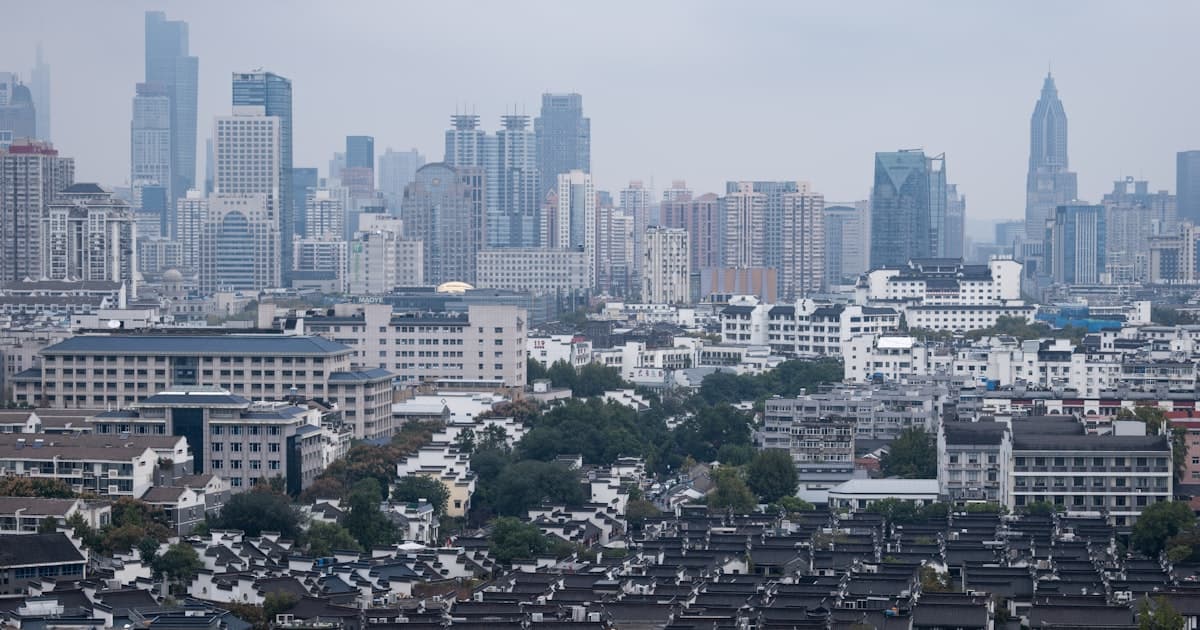

USA vs China at a glance: the US leads in GDP ($28.8T vs $17.8T) while China leads in population (1.41B vs 340M). We used the StatsPanda Comparison Tool to break down every major metric side by side — economy, GDP per capita, education, health, military, and innovation.
The USA vs China at a Glance
When it comes to the USA vs China comparison, there is no rivalry that shapes the 21st century more. The United States leads as the world's largest economy with a GDP of $28.8 trillion, while China follows at $17.8 trillion — but with four times the population. Using StatsPanda's Comparison Tool, we pulled side-by-side data across population, economy, demographics, health, education, and innovation to give you the definitive USA vs China data breakdown.
| Metric | United States | China |
|---|---|---|
| Population | 340 million | 1.41 billion |
| GDP (Nominal) | $28.8 trillion | $17.8 trillion |
| GDP Per Capita | $85,370 | $12,720 |
| Life Expectancy | 77.5 years | 78.2 years |
| Median Age | 38.5 years | 39.0 years |
| Urban Population | 83% | 65% |
| CO2 Emissions Per Capita | 14.4 tonnes | 8.0 tonnes |
| Internet Users | 92% | 75% |
| R&D Spending (% GDP) | 3.5% | 2.4% |
| Literacy Rate | 99% | 97% |
| Health Expenditure (% GDP) | 17.8% | 5.6% |
| Land Area | 9.15 million km² | 9.39 million km² |
Want to explore every metric yourself? Open the StatsPanda Comparison Tool and compare the United States vs China across all 12 data categories with 150+ indicators.
USA vs China Economy: GDP, Trade, and Growth
The USA vs China GDP comparison is the centerpiece of their global rivalry. The United States maintains a commanding lead with a nominal GDP of $28.8 trillion to China's $17.8 trillion. However, when measured by purchasing power parity (PPP), China's economy has already surpassed the U.S. — a fact that underscores how different the two economies are in structure.
GDP per capita reveals the starkest contrast. At $85,370, the average American produces nearly seven times more economic output than the average Chinese citizen at $12,720. This gap reflects the U.S. advantage in high-value services, technology, and financial sectors, while China's economy still relies heavily on manufacturing and construction.
China's GDP growth rate has averaged 5-6% in recent years compared to America's 2-3%, but the gap is narrowing as China's economy matures. The U.S. unemployment rate sits around 3.7%, while China reports roughly 5.2% — though labor market data from both countries carries its own caveats.
In international trade, China exported $3.6 trillion in goods in 2025, making it the world's largest exporter. The U.S. exported roughly $2.1 trillion. The trade balance tells a dramatic story: China runs a massive surplus while the U.S. carries persistent deficits, a dynamic that fuels ongoing economic tensions between the two nations.
USA vs China Population and Demographics
The USA vs China population comparison shows a 4x gap: China's 1.41 billion dwarfs America's 340 million. But the trajectory is shifting. China's population peaked in 2022 and is now declining, with a fertility rate of just 1.0 — well below the 2.1 replacement level. The United States, with a fertility rate of 1.66, still grows slowly thanks to immigration.
Median age is nearly identical — 38.5 years in the U.S. versus 39.0 in China — but China's aging crisis is more severe. By 2050, over 30% of China's population will be 65 or older. The U.S. faces aging challenges too, but immigration provides a demographic buffer that China lacks.
Urbanization tells another story. The U.S. is 83% urban, a mature pattern. China at 65% is still urbanizing rapidly, with millions moving from rural areas to cities each year — one of the largest internal migrations in human history.
USA vs China Health and Education
In the USA vs China healthcare comparison, a surprising result emerges: China's life expectancy of 78.2 years now exceeds America's 77.5 years. This reversal — unthinkable a generation ago — reflects China's massive investments in public health infrastructure alongside America's struggles with obesity, opioid addiction, and healthcare costs.
The U.S. spends 17.8% of GDP on healthcare, more than three times China's 5.6%. Despite this enormous spending gap, the United States does not achieve better aggregate outcomes. Infant mortality in the U.S. stands at 5.4 per 1,000 live births versus China's 5.1, another metric where China has closed the gap.
In education, both nations invest heavily but in different ways. The U.S. has the world's strongest university system, with 8 of the top 10 globally ranked institutions. China has rapidly expanded tertiary enrollment to over 60%, up from 15% in 2002. The USA vs China education comparison shows converging literacy rates (99% vs 97%) but divergent strategies: the U.S. emphasizes breadth and creativity while China focuses on STEM and scale.
USA vs China Innovation and Environment
The USA vs China innovation comparison shows a fierce technology race. The U.S. spends 3.5% of GDP on R&D compared to China's 2.4%, but in absolute dollars China is closing fast, now spending over $400 billion annually on research. China leads the world in patent applications, filing more than 1.5 million per year. The U.S. leads in patent quality and scientific citation impact.
On the environment, the contrast is stark. China produces roughly 11.4 billion tonnes of CO2 annually — more than the U.S. and EU combined. But per capita, Americans emit 14.4 tonnes compared to China's 8.0 tonnes. China has also become the world's largest investor in renewable energy, installing more solar capacity in 2025 alone than the U.S. has built in total.
Key Takeaways: USA vs China Comparison
- Economic power: The U.S. leads in nominal GDP ($28.8T vs $17.8T), but China leads in PPP-adjusted output and trade volume
- Living standards: GDP per capita in the U.S. is nearly 7x higher, but China has raised 800 million people out of poverty since 1980
- Demographics: China's population is 4x larger but shrinking; America grows slowly through immigration
- Health: China now edges the U.S. in life expectancy despite spending a fraction of GDP on healthcare
- Innovation: The U.S. leads in research spending (% GDP) and university quality; China leads in patent volume and renewable energy deployment
- Environment: China is the largest total emitter; the U.S. emits far more per person
Explore the Full USA vs China Comparison
This article only scratches the surface. Use StatsPanda's free Comparison Tool to compare the United States and China across 150+ metrics including governance, infrastructure, cost of living, and financial indicators.
Try the Comparison ToolUnlock All the Data
Free users get access to Population, Economy, and Demographics categories. Subscribe to unlock all 12 data categories including Health, Education, Innovation, Environment, and more — plus CSV and Excel export.
Subscribe for Full AccessMethodology
Data sourced from the World Bank Open Data, United Nations Population Division, WHO Global Health Observatory, and UNESCO Institute for Statistics. GDP figures reflect nominal USD for 2025. Population estimates are mid-2025 projections. All metrics are the latest available year. Explore the full dataset and compare any two countries at statspanda.com/tools/compare.