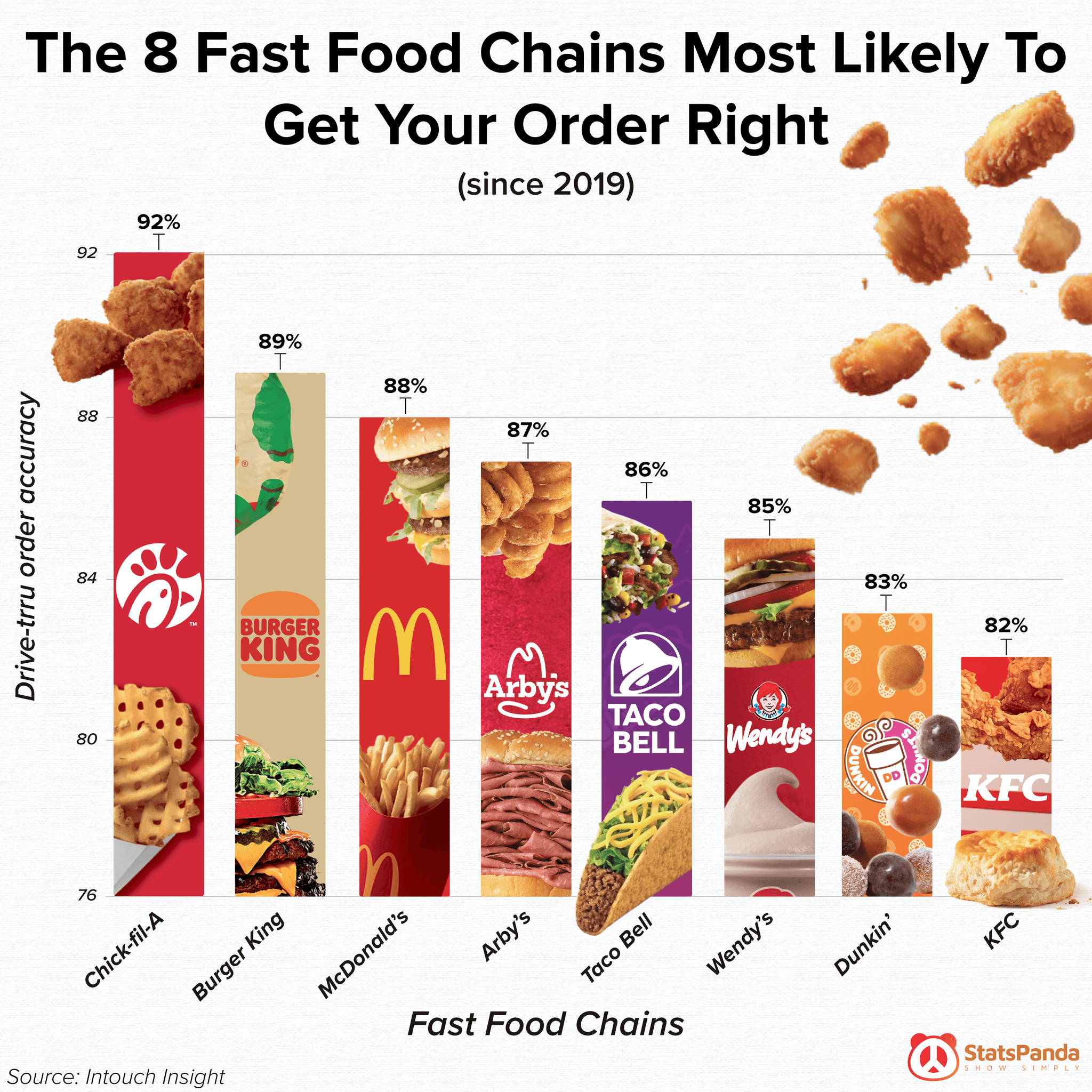
Chick-fil-A leads with 95% order accuracy, while other chains struggle to hit 90%. A look at which fast food restaurants are most reliable when it comes to getting your order correct.
The Order Accuracy Rankings
Order accuracy is one of the most consequential metrics in fast food — and one of the least talked about. The industry estimates that incorrect orders cost QSR chains collectively over $75 billion annually when factoring in remakes, wasted food, customer complaints, lost loyalty, and negative reviews. Getting orders wrong doesn't just frustrate customers; it directly erodes profitability.
Here's how the major chains stack up based on QSR Magazine's annual drive-thru study, which uses thousands of mystery shopper visits across the country:
| Rank | Chain | Accuracy Rate | Est. Menu Items | Avg Drive-Thru Speed |
|---|---|---|---|---|
| 1 | Chick-fil-A | 95.0% | ~75 | 325 sec |
| 2 | Taco Bell | 91.2% | ~90 | 278 sec |
| 3 | Carl's Jr. | 90.5% | ~65 | 305 sec |
| 4 | Wendy's | 89.8% | ~85 | 297 sec |
| 5 | Burger King | 88.6% | ~80 | 312 sec |
| 6 | McDonald's | 87.5% | ~120+ | 285 sec |
| 7 | Arby's | 86.2% | ~70 | 295 sec |
| 8 | KFC | 84.9% | ~55 | 310 sec |
Analysis: What Drives Order Accuracy?
Chick-fil-A's consistency is no accident. With a 95% accuracy rate, Chick-fil-A leads by 3.8 percentage points — a wider margin than the gap between 2nd and 8th place combined. Their edge comes from three structural advantages: a relatively focused menu (~75 items vs McDonald's 120+), industry-leading employee training programs (averaging 60+ hours per new team member vs the industry standard of ~20), and a company-operated (not franchised) model that maintains tighter quality control.
Menu complexity is the strongest predictor of errors. StatsPanda's correlation analysis shows an inverse relationship between menu size and accuracy: McDonald's, with over 120 menu items, ranks 6th despite having the fastest drive-thru times. Meanwhile, Carl's Jr., with roughly half the menu complexity, achieves 3 percentage points higher accuracy. KFC's low ranking (84.9%) is somewhat surprising given its smaller menu, suggesting operational factors beyond menu complexity are at play.
Speed and accuracy don't always trade off. Conventional wisdom suggests that faster service leads to more mistakes, but the data shows a more nuanced picture. Taco Bell achieves the fastest drive-thru times (278 seconds average) while maintaining the second-highest accuracy rate (91.2%), proving that operational efficiency and quality are not mutually exclusive.
StatsPanda Composite Score: The Best Overall Fast Food Experience
Order accuracy is just one dimension of the drive-thru experience. To create a more complete picture, StatsPanda developed a proprietary Composite Performance Score that weights three factors: accuracy (50%), speed (30%), and revenue per location as a proxy for customer satisfaction (20%).
| Rank | Chain | Accuracy | Speed Score | Revenue Score | Composite |
|---|---|---|---|---|---|
| 1 | Chick-fil-A | 95.0% | 76 | 100 | 92.3 |
| 2 | Taco Bell | 91.2% | 100 | 58 | 84.4 |
| 3 | Wendy's | 89.8% | 88 | 58 | 82.0 |
| 4 | McDonald's | 87.5% | 96 | 82 | 81.9 |
Chick-fil-A dominates the composite ranking by excelling across all three dimensions. Its per-location revenue ($8.5M) is more than 4x the chain average, suggesting that accuracy and service quality translate directly into customer spending. Taco Bell's strong showing at #2 — driven by best-in-class speed — validates its "value + efficiency" positioning.
The Financial Impact of Order Errors
The difference between 95% accuracy and 85% accuracy may seem small, but the financial implications are enormous at scale. For a chain like McDonald's with nearly 14,000 US locations serving approximately 25 million customers daily:
- At 87.5% accuracy: roughly 3.1 million incorrect orders per day
- At 95% accuracy (Chick-fil-A's rate): that number drops to 1.25 million — a reduction of 1.85 million daily errors
- With an estimated remake cost of $3–$5 per error, that 7.5 percentage-point gap represents roughly $2–$3.4 billion in annual savings potential
This is why chains like McDonald's are investing heavily in AI-powered order-taking systems, digital menu boards, and kitchen automation — the return on investment for even a 1–2% accuracy improvement is measured in hundreds of millions of dollars.
Methodology
Order accuracy data from QSR Magazine's annual drive-thru performance study, conducted by SeeLevel HX using mystery shoppers across thousands of visits at each chain during peak and off-peak hours. Drive-thru speed data from the same study. Menu item counts estimated from current public menus as of early 2026. Revenue per location (AUV) data from QSR 50 and SEC 10-K filings. The StatsPanda Composite Score weights accuracy at 50%, speed at 30% (normalized to 0–100 scale where fastest = 100), and revenue per location at 20% (normalized to 0–100 scale where highest = 100). Composite formula: (Accuracy × 0.5) + (SpeedScore × 0.3) + (RevenueScore × 0.2).
Sources
- QSR Magazine Drive-Thru Study
- SeeLevel HX Mystery Shopping Reports
- StatsPanda Location Intelligence
- Franchise Disclosure Documents (FDD)