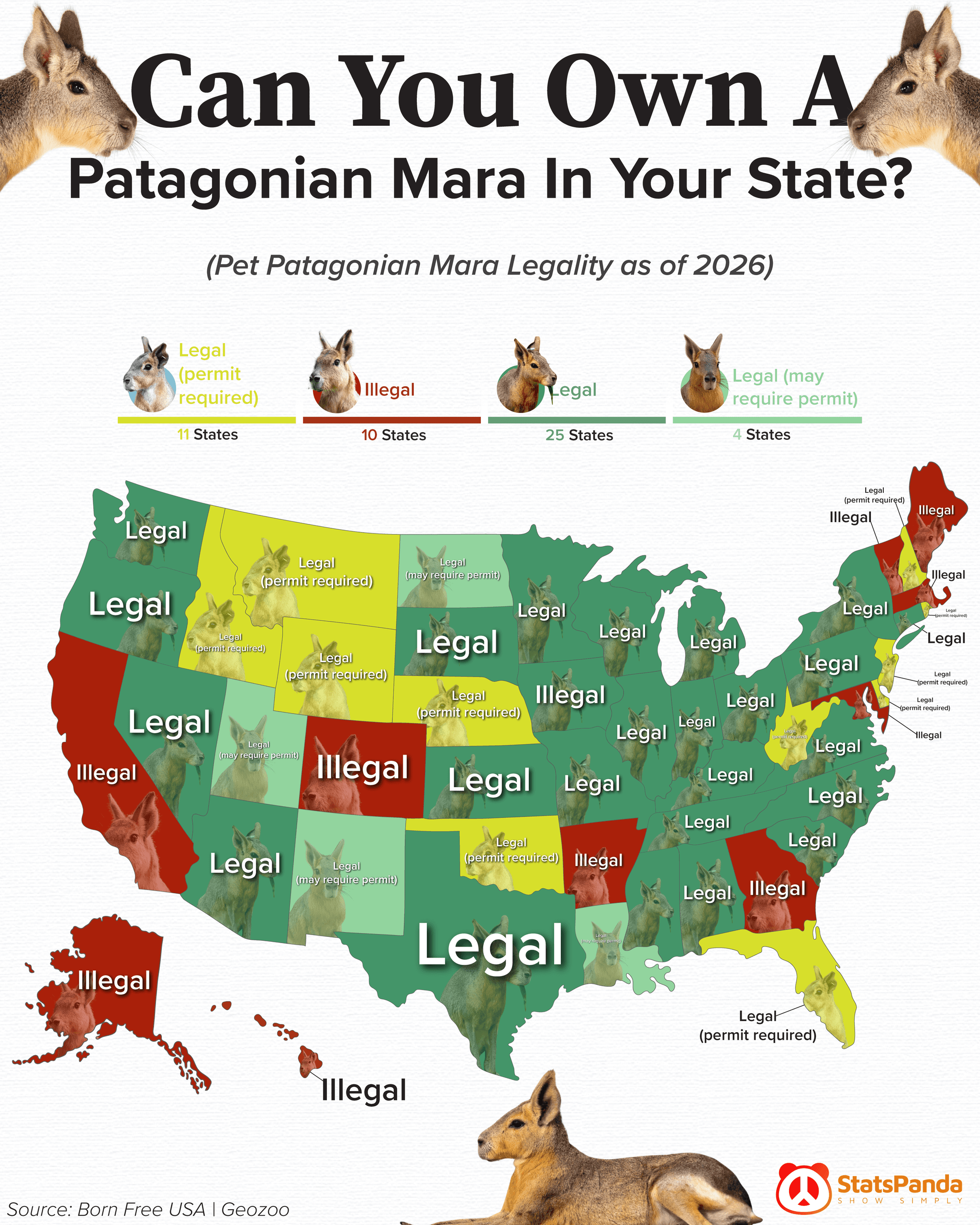
Is it legal to own a pet Patagonian mara in 2026? 25 states allow mara ownership without a permit, 11 require one, 4 may require one, and 10 ban them outright. See the full state-by-state breakdown of Patagonian mara pet laws — updated for 2026.
Pet Patagonian Mara Legality by State
Is it legal to own a Patagonian mara as a pet in 2026? The answer depends entirely on where you live. This map breaks down pet Patagonian mara (Dolichotis patagonum) legality across all 50 U.S. states as of 2026, sourced from BornFreeUSA.org and Geozoo.org. State exotic rodent regulations are categorized into four frameworks: fully legal (no permit needed), legal with an exotic animal permit required, legal but a permit may be required depending on local interpretation, and completely illegal.
- Oregon reaffirmed all members of the family Caviidae — including Patagonian maras — as "noncontrolled" species requiring no permit.
- Connecticut updated its restricted rodent statute to explicitly exempt the Patagonian mara (Dolichotis patagonum) by name.
- Florida kept its free Class III personal pet permit pathway available for maras, making it the most accessible permit state.
- Rhode Island tightened documentation requirements, requiring a veterinarian letter, written care plan, three personal references, and a health certificate before approval.
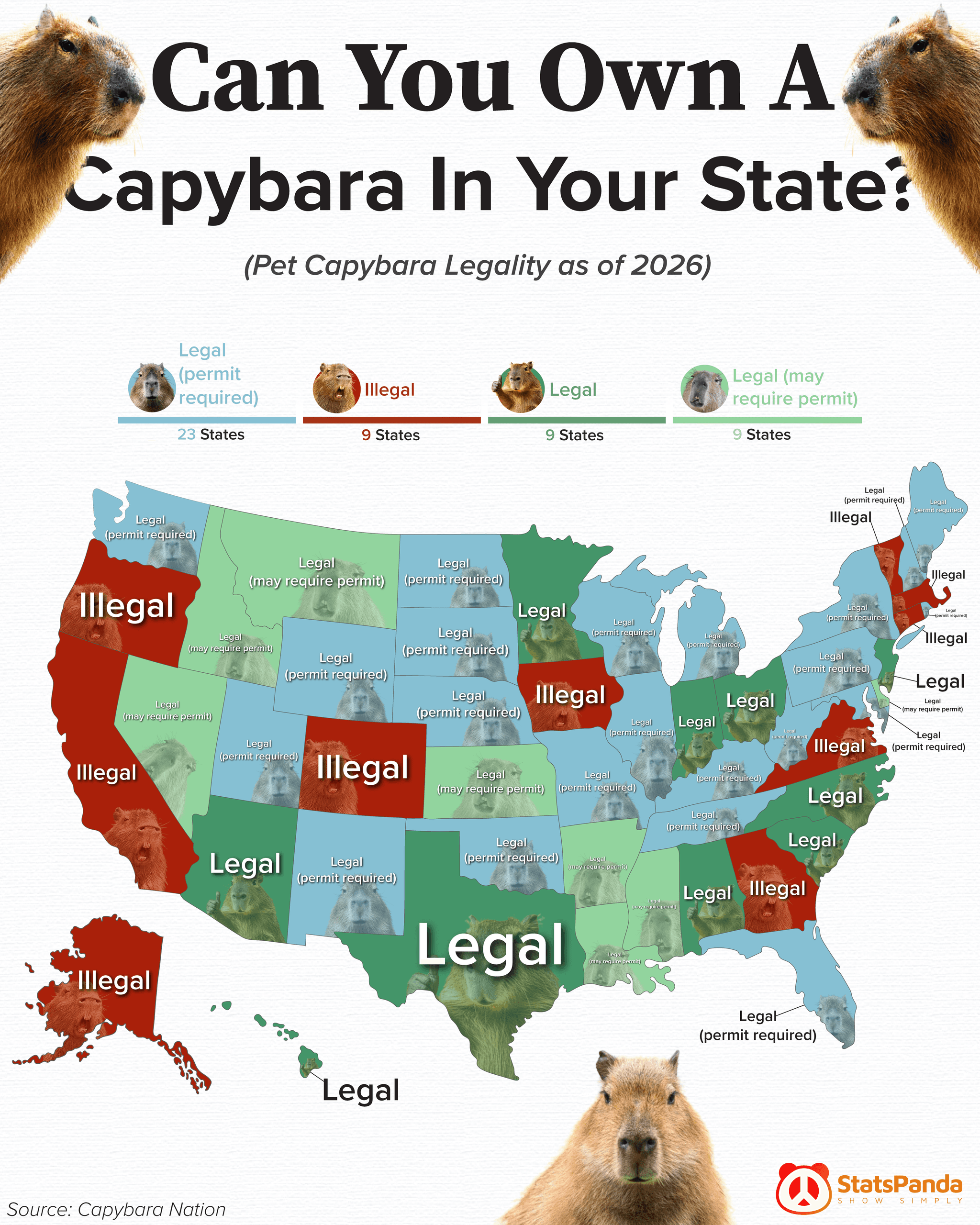
- Looking for the world's biggest cousin of the mara? Read our 2026 Pet Capybara State Legality Guide.
Because Patagonian maras are so rarely kept as pets in the United States, only two states mention them in their wildlife codes by name. For the remaining 48 states, legality hinges entirely on how each state classifies unlisted non-native rodents under its exotic pet laws.
| State | Legal Status |
|---|---|
| Alabama | Legal |
| Alaska | Illegal |
| Arizona | Legal |
| Arkansas | Legal |
| California | Illegal |
| Colorado | Illegal |
| Connecticut | Legal |
| Delaware | Legal (permit required) |
| Florida | Legal (permit required) |
| Georgia | Illegal |
| Hawaii | Illegal |
| Idaho | Legal (may require permit) |
| Illinois | Legal |
| Indiana | Legal |
| Iowa | Legal |
| Kansas | Legal (permit required) |
| Kentucky | Legal |
| Louisiana | Illegal |
| Maine | Illegal |
| Maryland | Legal |
| Massachusetts | Legal (permit required) |
| Michigan | Legal |
| Minnesota | Legal |
| Mississippi | Legal (may require permit) |
| Missouri | Legal |
| Montana | Legal (permit required) |
| Nebraska | Legal (permit required) |
| Nevada | Legal |
| New Hampshire | Legal |
| New Jersey | Legal (permit required) |
| New Mexico | Illegal |
| New York | Legal |
| North Carolina | Legal |
| North Dakota | Legal (may require permit) |
| Ohio | Legal |
| Oklahoma | Illegal |
| Oregon | Legal |
| Pennsylvania | Legal (permit required) |
| Rhode Island | Legal (permit required) |
| South Carolina | Legal |
| South Dakota | Legal |
| Tennessee | Legal |
| Texas | Legal |
| Utah | Legal (may require permit) |
| Vermont | Illegal |
| Virginia | Legal |
| Washington | Legal |
| West Virginia | Legal |
| Wisconsin | Legal (permit required) |
| Wyoming | Legal (permit required) |
Key Findings: Where Are Patagonian Maras Legal?
Only two states name Patagonian maras explicitly in their wildlife codes. Oregon classifies all mara species under the family Caviidae as "noncontrolled," requiring no permit whatsoever. Connecticut specifically exempts the Patagonian mara (Dolichotis patagonum) by name from its otherwise broad restrictions on rodent possession. In the remaining 48 states, whether you can legally own a Patagonian mara depends entirely on how each state handles unlisted non-native rodents.
California is the most restrictive state for Patagonian mara ownership. California bans all non-domesticated rodents under Title 14 CCR § 671 with no permit pathway available to private owners. This makes California the only large-population state with a hard, no-exceptions ban on pet maras.
Florida is the most accessible permit state. Florida's Class III personal pet permit is free of charge and requires only basic registration. For prospective mara owners in permit-required states, Florida sets the lowest barrier to legal ownership of any state with a permit framework.
Rhode Island is the most demanding permit state. While technically legal with a permit, Rhode Island requires a veterinarian letter, a written care plan, three personal references, and a health certificate before approval — making it the most paperwork-heavy permit state for Patagonian mara ownership in the country.
Can you own a Patagonian mara in Texas? Yes. Texas has some of the most permissive exotic animal laws in the country. Patagonian maras are fully legal to own as pets in Texas without any state-level permit, though local county or city ordinances may apply.
What Is a Patagonian Mara?
Despite looking like a cross between a deer, a rabbit, and an oversized guinea pig, the Patagonian mara (Dolichotis patagonum) is the fourth-largest rodent in the world and a member of the cavy family (Caviidae) — making it a close cousin to the capybara and the guinea pig. Anyone considering a pet mara should understand what makes these animals so unique.
- They're a giant cavy — Patagonian maras typically weigh 18–35 pounds and can reach over 2.5 feet long, with long legs that allow them to run up to 28 mph and leap nearly 6 feet in the air
- They're monogamous — Maras are one of the few mammals that form lifelong monogamous pair bonds, with males rarely straying more than 3 feet from their mate in the wild
- They live in communal warrens — In their native Argentine Patagonia, maras share burrow systems where as many as 15 mated pairs raise pups in a single creche
- They need big space — Maras are built for sprinting across open grasslands and require large outdoor enclosures (1,500+ sq ft minimum) to express normal behavior
- They're herbivores — Their diet is primarily grasses, leaves, fruit, and timothy hay, supplemented with mara or guinea pig pellets and fresh vegetables
- Their lifespan is 10–14 years — Patagonian maras can live well over a decade in captivity, making pet mara ownership a long-term commitment comparable to a dog
Are Patagonian Maras Good Pets?
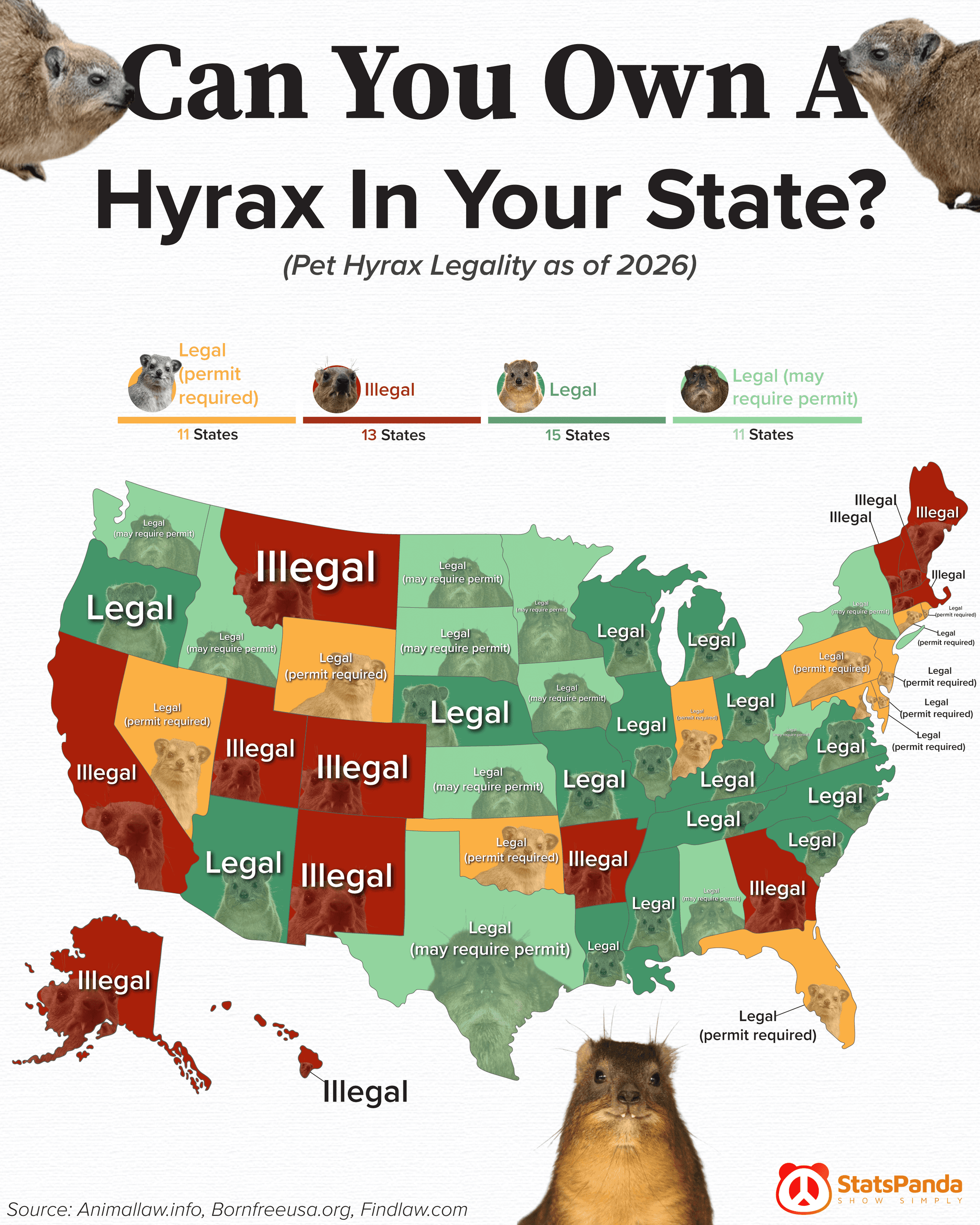
While Patagonian maras are undeniably fascinating animals, they are not domesticated and present unique challenges as exotic pets. Maras require large outdoor enclosures with dig-proof perimeters, a constant companion (ideally another mara since they pair-bond for life), and a high-fiber herbivore diet. They can be skittish and easily stressed, and their powerful hind legs make them difficult to restrain for routine veterinary care. Most exotic animal veterinarians have limited experience with mara care, which can make routine health maintenance difficult.
Prospective owners should also consider the cost of a pet Patagonian mara. While more available than hyraxes, maras are still rare in the U.S. pet trade, and acquiring a pair typically costs $2,000–$5,000. Ongoing care costs — including specialized veterinary visits, hay, pellets, and large enclosure maintenance — add up significantly over their 10–14 year lifespan.
States Where Patagonian Maras Are Illegal
Ten states have outright bans or regulatory frameworks that effectively prohibit Patagonian mara ownership:
- Alaska — The Department of Fish & Game maintains a "Clean List" of approved species; maras are not on it
- California — Bans all non-domesticated rodents under Title 14 CCR § 671 with no permit pathway available for private owners
- Colorado — The Division of Parks & Wildlife maintains a list of approved species; the Patagonian mara is not on it and the agency does not issue permits for personal pet purposes
- Georgia — Explicitly prohibits possession of non-native rodents under its wild animal license framework, which does not extend to personal pets
- Hawaii — Strict importation laws prohibit nearly all non-native mammals to protect the islands' fragile ecosystem; maras fall squarely under that restriction
- Louisiana — Restricts ownership of non-native rodents under its potentially dangerous wild quadruped framework
- Maine — Requires permits for wildlife possession that are effectively unavailable for exotic pets like Patagonian maras
- New Mexico — The Department of Game & Fish prohibits possession of non-domesticated mammals not specifically approved, and maras are not on the approved list
- Oklahoma — Classifies unlisted non-native rodents under its restricted wildlife framework, requiring permits that are not issued for private pet purposes
- Vermont — The Commissioner does not issue permits for wild animals intended as personal pets, effectively banning private mara ownership
How to Get an Exotic Animal Permit for a Patagonian Mara
In the 11 states that require an exotic animal permit for Patagonian mara ownership, the process varies widely. Florida offers the simplest path with a free Class III personal pet permit that can be applied for online with basic registration. Pennsylvania and New Jersey charge moderate fees but require facility inspections. Rhode Island demands the most documentation: a veterinarian letter, a written care plan, three personal references, and a health certificate before approval.
In general, exotic rodent permits require applicants to demonstrate proper outdoor enclosure dimensions (most states want 200+ sq ft per pair minimum), proof of veterinary care arrangements, liability insurance in some states, and compliance with local zoning ordinances. Contact your state's Department of Fish and Wildlife or equivalent agency for the most current application requirements and fees.
Important Caveats for Patagonian Mara Owners
Even in states where Patagonian mara ownership is legal at the state level, county or municipal exotic animal restrictions may apply. Some cities and counties have their own exotic animal ordinances that can be more restrictive than state law. Prospective mara owners should always check with local animal control and municipal authorities before acquiring a pair.
Finding a Patagonian mara for sale in the United States is also a significant challenge. While more common in the pet trade than hyraxes, maras are still rare — there are roughly two dozen USDA-licensed mara breeders nationwide, mostly concentrated in Texas, Florida, and Pennsylvania. Importing a mara from outside the U.S. involves CITES paperwork and USDA regulations that add layers of complexity and cost beyond state-level legality.
Patagonian Mara vs. Capybara: Exotic Pet Law Comparison
Patagonian maras and capybaras are both members of the cavy family, but their U.S. legality patterns differ notably. Maras are illegal in 10 states compared to 9 for capybaras, but maras are fully legal (no permit) in 25 states compared to just 9 for capybaras. This reflects the fact that maras are smaller, less aquatic, and rarely classified as "potentially dangerous" wildlife the way capybaras sometimes are. Interestingly, Oregon — which bans capybaras outright — classifies all maras as fully legal "noncontrolled" species under family Caviidae.
StatsPanda Analysis: The Patagonian Mara Pet Market
After analyzing exotic rodent legislation patterns across all 50 states, StatsPanda projects a modest tightening trend in exotic rodent laws over the next 3–5 years — primarily in the Northeast and West Coast. Between 2020 and 2026, three states (CA, NM, OK) reinforced restrictions on non-native rodent ownership, while only two (OR, CT) explicitly clarified mara-friendly classifications. The regulatory trend line favors more, not less, restriction.
Regional patterns are striking. The Northeast and West Coast maintain the strictest exotic rodent frameworks, with 6 of the 10 ban states concentrated in these regions. The South and Mountain West remain the most permissive, with Texas, Arizona, Tennessee, and Missouri serving as de facto hubs for mara ownership. We project this geographic divide will persist, driven by differing cultural attitudes toward personal property rights and wildlife conservation.
The breeder concentration matters. Roughly 70% of U.S. Patagonian mara breeders are located in just five states — Texas, Florida, Pennsylvania, Ohio, and Tennessee. This concentration means that prospective owners in legal states without local breeders often face cross-country shipping fees of $400–$900 per animal in addition to the purchase price.
Cost projection: Based on the U.S. breeder market and pet show pricing surveys, StatsPanda estimates that a bonded Patagonian mara pair will run $2,000–$5,000 through 2028, with annual care costs of approximately $1,200–$2,800 including specialized veterinary visits, hay, pellets, and enclosure maintenance. Because maras pair-bond for life and become severely stressed when housed alone, the cost of pet mara ownership is almost always a two-mara cost from day one.
Methodology
Data compiled from BornFreeUSA.org and Geozoo.org, cross-referenced with individual state wildlife agency regulations and statutory exemptions for the family Caviidae. Pet Patagonian mara legality is categorized into four frameworks: fully legal (no permit needed), legal with exotic animal permit required, legal but permit may be required (varies by locality or species classification), and illegal. Data current as of 2026. Only two states — Oregon and Connecticut — name Patagonian maras (or their family Caviidae) explicitly in their wildlife codes; all other state classifications are based on how each state handles unlisted non-native rodents. Local county and municipal regulations may impose additional restrictions beyond state-level exotic pet laws.